
Episode 164
53 mins
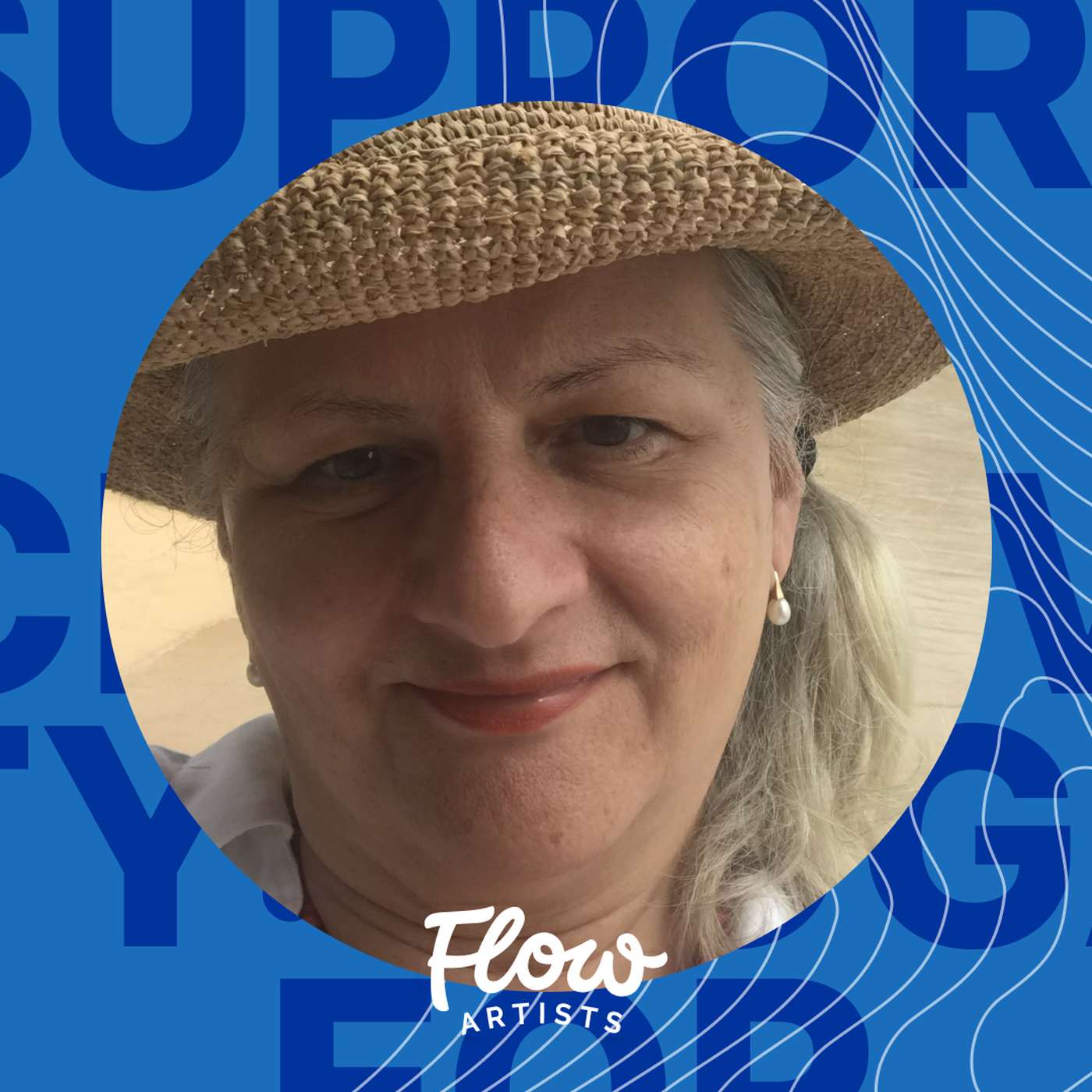
Supporting Creativity: Yoga for Good with Moira Gordon
In our latest episode, we sit down with Moira Gordon, Director of the Yoga for Good Foundation, for wide-ranging chat that weaves together personal storytelling and practical advice. Moira shares how she first discovered yoga as a teenager in rural Staffordshire, England through library books featuring Indra Devi. She was 12 or 13, teaching herself postures from photographs on her family's lawn. That self-directed curiosity never left her.
Moira shares about her unique fusion practice, Yatoga, which combines visual art-making with yoga — "putting art in yoga, or wrapping yoga around art." She talks about the deep meditative states that creative work like collage and painting can unlock, and why this approach offers an accessible doorway for people who struggle with traditional sitting meditation. Jo, who received a Yoga for Good grant herself to fund photography for her book Eight Limbs of Aerial Yoga, brings her perspective to the conversation as both host and former recipient.
The heart of the episode is a frank, practical look at how the Yoga for Good Foundation works — and how you can apply. Moira explains how the foundation grew from the difficult closure of the Satyananda Yoga Academy and its Mangrove Mountain Ashram, transforming grief into something generative. Her insight was simple but powerful: "Yoga's just as creative as being an artist or a dancer or a playwright or whatever. Why can't we have grants for yogis?" She walks through the grant process, the SMART framework for building a strong proposal, common application mistakes to avoid, and why even unsuccessful applicants often walk away with something valuable — clarity about their own vision.
Whether you're a seasoned teacher with a project idea gathering dust, or someone just starting to imagine what you might create, this episode is full of encouragement and actionable guidance. As Moira puts it, anything done from the heart is worth pursuing, and now, there might just be funding to help you do it.
Transcription
Please email us to report any transcription errors
Rane: Hello, my name is Rane Bowen, and this is the Flow Artist Podcast. Together with my co-host Jo Stewart, we speak with extraordinary movers, thinkers, and teachers about how they find their flow and much, much more. But before we dive in, we want to take a moment to acknowledge and honour the traditional owners of the unceded land where this episode was recorded, the Wurundjeri people of the Kulin Nation. We pay our deepest respects to the Elders both past and present and acknowledge the emerging leaders within their community. In this episode, we're speaking with Moira Gordon. Moira is a director at the Yoga for Good Foundation, YFG, a yoga teacher, and runs workshops that combine yoga and art to find your purpose, Yatoga. Yoga for Good supports yoga in the community with small grants for projects from the heart and innovation to bring the benefits of yoga to those in need. The Yoga For Good Foundation was formed after the closure of Satyananda Yoga Ashram at Mangrove Mountain. While we don't go into detail, we wanted to give you, the listener, the content advice that we briefly talk about this aspect of Australia's yoga history. Many of Yoga For Good's grant recipients focus on trauma-informed practise in making yoga more accessible to marginalised communities, and Moira has many helpful suggestions for writing a successful grant proposal. Full disclosure, Jo also got a grant for her book from Yoga for Good. It's a great conversation with lots of useful information, and we hope you enjoy listening. All right, well, Moira, thank you so much for speaking with us today. It's great to finally get the chance to talk to you. Perhaps you could start by telling us just a little bit about your background and where you grew up.Moira: Well, I'm actually English. I came to Australia in 1991. I had to think about it. It was a long time ago. So yeah, I was brought up in rural Staffordshire in, in a farmhouse outside a village. So it was, I was very blessed to be surrounded by nature and How did you discover yoga? Well, being living quite isolated, I actually discovered yoga as a teenager in the village library of all places. Yes, I found, I found the books fascinating. My first discovery was Indra Devi, who was one of the first female yogis who who learned her yoga under Krishnamacharya, and she was a very audacious lady. She wouldn't take no for an answer. And she was a, a Russian immigrant. And so she went to India and then she, then she took herself to Hollywood and started teaching the stars and was into health and beauty. And Gloria Swanson was my favourite. The pictures of Gloria Swanson doing yoga on the lawn. So I used to emulate Gloria Swanson on our lawn when I was about 12 or 13. Yeah. Doing all the postures and yeah.
Jo: Did you just learn from the book? Just from looking at the pictures and reading the words? Yeah.
Moira: Yeah. Because I didn't have any, like, I wanted to be a ballet dancer, but we didn't have a ballet school near. So I learned, I thought I knew ballet from pictures too. So. Discovering yoga, I thought, oh, this is just another form of physical interpretation, you know, and culture. And I did get into it quite a bit actually. And I was quite, I was sporty. I was an athlete at school and I used to run a lot, jump, and I used to get aching legs and the stretching used to really help because at that age, really, they just pick you for your natural ability. They don't do any training. It's like later on. When you're gonna be serious about the athletics, then you go to sports club and you get proper coaching. But at my age, like 12, 13, we would just run for our life, you know, and jump as high, you know, jump when we were told to jump. And yeah, I was in the school team and yeah, I remember being very tired and aching a lot and the yoga really helped. So yeah, I discovered it for myself and then I started getting more into the Raja Yoga side as well. I was, because my, I was brought up quite spirit, uh, well, I was brought up within, within the Christianity, the spiritual tradition. So I was aware of a world outside the physical and the idea of the third eye and Raja Yoga really appealed to me and that was the '70s. There was a lot of influx of Indian migrants in our local town. So I was totally fascinated with the colour and the look of the people. And so I was interested in, we did comparative religion at school, you know, cuz we were in this, even though it was very rural and English, it was multicultural. You know, we had West Indians, East Indians, Pakistanis. So we had all the different religions. So it was good that they actually had a, you know, discussion. So we, we used to talk about, you know, well, is there karma? You know, is there a heaven or a hell? Or do we all get reincarnated? You know, it was a fascination for us in the, in the '70s. And of course there was all the Maharishi, you know, TM and Yeah. So the whole of the culture was quite spiritual in a way.
Jo: It sounds like that would be a really inspiring environment to grow up with because often like when you imagine growing up in like a rural environment, like you don't really get to experience that much of the culture from the rest of the world. So it's kind of great that your village had such a—
Moira: Yeah, well it was— yeah, yeah, exactly. It was, the village was very I mean, it was just like something out of Midsommar's murders or whatever, you know, like these little villages and country estates and things like that. But the, the town was only 10 kilometres, 10 miles away, and that we had a huge influx of migrants in the '70s. So yeah, West Indians, East Indians, Pakistanis, Sikhs, a lot of Sikhs. So, you know, there was all these different people. You go to the market in the town and there was all these this food, all this different food and curries, like everyone was into eating curry and yeah, so it was, it was vibrant. And of course, you know, the Caribbean as well. That was lovely too. You were all the, all the reggae and the, the Indian music as well. Bhangra, which is like a form of Indian pop music, is like the beat, the Sikh beat set to, you know, like more popular music that was founded in Birmingham, which was our biggest town, close to. So yeah, it was vibrant. It really fascinated me. It was fascinating.
Jo: And I know that creativity is really important to you and like a really big part of what you share. So that must have also been very inspiring creatively. Do you want to tell us a bit about your art life and your personal creative practise?
Moira: Yeah, well, it did inspire me because the, the pop scene was very interesting at that time as well, you know, glam rock. Sequins, long hair, fur, lace, you know, Marc Bolan, Slade, people like that. And also all the heavy metal and everything. So it was all costume, you know, it was really, really sort of romantic. And I, I went to art school at the age of 16. I left school to go to art school.
Rane: Yeah.
Moira: So I was right into it. Yeah.
Jo: And so now that you, like, I read that you teach I'm not even sure how to say this word, but Yatoga. So art plus yoga workshops. Do you want to tell us a bit about that?
Moira: Yeah. Yatoga is a brand that I made up. It's like putting art in yoga or wrapping yoga around art. And I came up with, with that word because I'd seen a few different fusions of like yoga and creativity, but that one really, that one just really resounded to me. And I, I spent most of the lockdown doing a visual creative journaling, or I was part of a visual journaling studio in America. And I did this course, like, with this lady who, Lisa Sonora, she was actually a student of Julia Cameron, who did The Artist's Way. So it's a form of creativity, which is process. And so it's not, it's not art therapy. I spent about 3 years doing really intensive visual journaling and it's, it was to really discover my true essence and it was very transformative. So when I, when I'm doing my, my collages and playing with paint, paper and pastels and things, I, I see it as like I'm doing Yatoga because I, I often combine it with after I've done my yoga stretches, or it's inspired by something that I'm doing in yoga and maybe like the, the discovery, it's the discovery of a path, which I think is the same as what we're doing when we, when we're practising yoga, we're discovering our inner journey. Yeah.
Jo: Yeah, absolutely. I feel like there's a very, very similar state of mind. And if you are someone who is easily distracted in the more like sitting, breathing, looking inwards meditation practises, like being creative, using your hands, using colour, it can be a way to get into some of those deeper states, but for me, it's a lot easier than just observing my mind and observing my breath to use like the expression. And like, I feel like it's a very similar state of mind, but like an easier path to get there the same way that movement can be as well.
Moira: Well, it's, it is an alternative, you know, it's a kind of meditation and people often report, you know, when they're deeply involved in, in making art that they lose all sense of, of time, place. They're just completely absorbed. And I think that's a really beautiful thing. And similar to when you're in a yoga class, you're, you're just deeply involved in what you're doing. You're very aware, you're very present.
Jo: And I like, I think there's another layer to it as well, because yoga really encourages us to like look beyond like rigid societal structures and like ways of experiencing the world that's like, why do we see things that way? Like, what are we— what's the lens that we're looking through kind of thing? And I think that like experiencing ourselves in new ways and like experiencing the world in a different way has been like a part of yoga practise and philosophy from the very beginning. And I actually love this quote from Aurobindo, which is, our yoga is not a retreading of old walks. But a spiritual adventure. Have you done much exploration into creativity throughout the history of yoga?
Moira: Yes.
Jo: Yeah.
Moira: I've, I've been, well, I actually, from art college, I became a graphic designer. So that in itself is visual communication. So give me a diagram and I'm right in there, you know? So I studied with the Satyananda Yoga Academy, I was one of their last students and there's a lot of art in that lineage and it's actually spiritual art and that is really instructive, you know, visually. And so that was a real exploration to almost, and I remember when I was doing the course, you know, it was really sort of quite heavy philosophy and and psychology of yoga, I'd mind map everything. It would become a diagram. And for me, that's, that's a way of learning to, to, to actually have that phys— you know, this, the sense, the visual sense. And also if you're actually drawing it, it's actually a mind, a mind-body pathway as well. Like it's a bridge, you know, it's a very expansive thing to do if you can actually draw something that represents something else. So I guess that's an exploration within yoga. Yeah, definitely.
Jo: Yeah. Like they, like yantras is part of that practise as well, right? Yeah.
Moira: And yeah. Yeah, exactly. As part of my Satyananda training, I did a tree yantra painting and I also did a course with them called Art in Yoga with a very accomplished Rishi, Rishi Diwali, and that was just absolutely mind-blowing for me. It was, it was just, it was just perfect. It was perfect. Yeah.
Jo: What, what kind of things did you do on that course?
Moira: Well, we did draw our own mandala and we had, we did some experiential drawing as well, like some very light drawing and then some very dark things as well. And also, we did some work with clay too. Yeah. So yeah, it was very, very exploratory, very interesting.
Jo: And yeah, yeah, no, it sounds amazing.
Moira: Yeah. And she's a, she's a fabulous artist as well. Yeah. And one of the things she got us to do as well was to connect with that inner child. She asked us to bring in a drawing, a photograph that we really liked of ourselves. And draw around that. And, uh, I did some very, very sort of spontaneous sketching and she said, oh, that's Ganesh. And sure enough it was. And I thought I'd just like done some like sort of swirls on the page and she was right, you know? So something came through, you know, just from, just from her creating that space.
Jo: Yeah. Amazing.
Moira: Yeah. Wow. And of course, you know, he's the symbolic, symbolises removing of obstacles. So I think that was really, um, a very transformative experience for me. I never forgot it. Yeah. So, yeah, I've worked with her lately as well with Yoga for Good. So it's really interesting the way that things layer, layer up over the years.
Jo: And are there any kind of go-to yoga practises that you intentionally do before you're sitting down to make your art? Like, is Is there anything that helps you get the creative juices flowing and remove the obstacles, so to speak?
Moira: Well, definitely my meditation. That is definitely clearing the mind and aligning myself with a deeper, deeper layer. You know, some people call it, you know, the field, you know, the oneness.
Jo: Yeah.
Moira: So I, I'm very experienced. I wouldn't say very experienced, but I am experienced over 10, right over 10 years with mantra meditation. And that is really clearing. But I, if I'm feeling overwhelmed or too much in my head and I wanted to switch to doing something, you know, some cre— it doesn't have to be something like on, on with art materials. It can be creative thinking too. Yeah. Just to have creative thoughts. Meditation's the key. And definitely, you know, if you're, if you're, if your body's uncomfortable, you need to release that, those tensions in the body. I don't think good art comes from a very tense mind and body. Yeah, I think no.
Jo: But unfortunately, the state of mind that you're sometimes in when you are really into it, I've definitely had those moments where I've like realised how hunched over whatever I'm working on I have become after a few hours. So it's good to have body awareness. And the reset so you don't end up with like neck pain afterwards.
Moira: Yeah. Like standing postures are very good. You know, the triangle is very good. Anything that opens the hips as well, because that's the creative energy centre of the body too.
Jo: And you've already mentioned a few people, but are there any artists or writers or philosophers that you look to now for inspiration?
Moira: Yeah, I thought about this actually before I came on. And one of the most amazing art shows that I've seen in recent years was, cheque her name, it's Hilma Alf Klint. K-L-I-N-T. And she was a Swedish artist and she did very intuitive drawings. And one of her major works was actually in New South Wales Art Gallery, and it was like a, a series of temple paintings. And they, that was just fabulous. And also she did a, a journey through life as well. You know, all the different stages of life, these huge paintings. And she did them very intuitively. I mean, they were like nothing you'd ever seen before. So she was one of the foremost abstract artists. Because they're all shapes and colours. They're just, they're just amazing. So I mean, I'll be continually inspired by that, I think.
Jo: Yeah, she's amazing. I know her work as well. Like if you like mandala, kind of intricate, they're not all symmetrical, but like that kind of, it makes you feel calm looking at them.
Moira: Yeah.
Jo: Like her colours are very harmonious and her work is so intricate, but also like not chaotic, like there's this sense of like the order of nature.
Moira: Yeah.
Jo: Within it.
Moira: Yeah. They're fabulous. They're really good. Yeah. And yeah, of course, you know, I've always been very interested in Jung as well, you know, the study of Jung, you know, because I did a liberal arts degree in the end after going to art college. So that was really fabulous. So I'm continually inspired by his work. And there's also, you know, a crossover as well into yoga. Swami Shampudev, um, Sarasvati, who done Yoga for Good's done a bit of work with him. And I think, you know, he was part of the Satchidananda as well. So that's really interesting, you know, that crossover there. And yeah, I'm continually reading as well. You know, I love, I love anything to do with, with the realisation of God, you know, Upanishads are just gorgeous. You know, you just go straight to the source. And at the moment I'm reading Like a Tree. Oh yeah. By Jeanne Shinoda Boleyn. I hope I said that right, but she's an activist, feminist, and she's a clinical psychologist and her work is really, really interesting. Yeah. So this is, this is the theme that we're using this year at Yoga for Good. The transformative power of nature. Amazing. Yeah.
Rane: Jo's book, Eight Limbs of Aerial Yoga, is out now. You can find out more and even download some of the creative exercises from within the book at eightlimbsofarealyoga.com. In the words of Nina Zolotow, past podcast guest and author of Yoga for Times of Change, this is a truly impressive book on aerial yoga. A subject I knew almost nothing about before reading through it. The book is not only very clearly written and comprehensive, but it helped me to understand the surprising number of benefits this form of yoga provides, as well as how to make the practise accessible to a very wide range of people of all ages, body types, and physical condition. If you're a regular podcast listener, you'll know how much love and energy Joe has put into this project, and it also features wisdom from many past guests, including a foreword by Jivana Heyman of Accessible Yoga. Eight Limbs of Aerial Yoga is available at all the major online retailers or ask for it at your local independent bookstore.
Jo: So, and this would be a great time to learn a bit more about Yoga for Good because like I'm a big fan, but for the people listening, could you explain a little bit about Yoga for Good as an organisation and who you you are and what you do.
Moira: Yeah, certainly. Well, Yoga for Good was set up as a charity. It's a foundation. It was set up in 2021 and it actually came out of the Satyananda lineage. I was one of the last people to actually train with the Satyananda Yoga Academy. And as part of that organisation was the, the Mangrove Mountain Ashram as well. And I put up my hand to help out with the governance and business side of it because after graphic design, I went into corporate business. And so I thought, well, what better way to use my skills than to actually help a yoga organisation? And so the result of They were in a lot of trouble in the 2010s. Yeah. So the result of that was they had to liquidate really all their assets and they couldn't use the academy name anymore. And it was very difficult at the time to make money from courses. The property that they had at Mangrove Mountain was really expensive to run. And so all their assets were liquidated. And so we have this legacy fund. And being an artist and doing management training, I realised that most artists exist through grants. So I thought, well, yoga's just as creative as being an artist or a dancer or a playwright or whatever. Why can't we have grants for yogis? So. This is what we set up. I got help to set it up, the grant scheme, and it's, it's gone really well. We're not short of people who, who want to apply for a grant. And we've fortunately, we've got enough funds to do a decent job of it every year. I mean, it would be nice to, you know, keep those funds that we've got. If we wanna give out more grants, we'll have to find another source of revenue for Yoga for Good so that we can extend it. Cuz we get so many great grants in. I, I just wanna give, give everyone grants, but unfortunately, you know, we have to just select a few. So every, at the moment, the last 3 years we are, we've been selecting about 20 people, 20 lucky people. Who can have a grant. So the grants range from 20,000 to 1,000, you know, or 2,000. Yeah, it can be the whole range of things. So it covers such a broad, so many broad categories of things. So basically it's people's passions, passion projects. That they want to get some help with.
Jo: Yeah, well, I was one of the lucky recipients of one of your grants, which is how I learned about Yoga for Good. And like, for me, it was really like a huge help. Like, it funded the photography section of my book, Eight Limbs of Aerial Yoga, and it really helped me bring my dream to life. And I feel like it's the only time, like as an independent yoga teacher, it's like often the things that you can dream about are limited by your capacity and your finances. And it's rare that a yoga project is going to be like a financial win. Like often you're hoping to just cover your own costs, especially if it is something that's not as commercial, like a bit more creative. So Like, I feel like a grant programme just makes so many more things possible that would have just stayed dreams, like, otherwise. So I think that's really amazing. And I actually didn't know the history of the foundation and, like, the time that you spoke about was, like, such a heartbreaking and, like, terrible time in Australia's yoga history. So, like, to have the vision of, like, looking to the future, I think is really like beautiful and powerful. And I've noticed that in your selection criteria, like, it's very focused on things that make yoga more accessible for people, especially for people in marginalised populations, and also programmes that have like a healing and a therapeutic kind of aspect to them. And I love that, like, that is where the intention is going. Like, it's a beautiful way to shape the future of yoga here in Australia. So thank you so much for everything. That you do. Do you want to take me through some of your past grant recipients?
Moira: Oh, yes, certainly. And it's really, really lovely of you to say what you just said about, about us, you know, because really it was, it was heartbreaking. And we wanted to do something that was non-commercial and that would benefit vulnerable people or, you know, people underserved. Because we could have carried on and the money would've been gone by now because of, you know, how, how, what the costs were, you know, to carry on as we were. And we just didn't have the people. So it was an, a, and it's a level playing field, like anyone can apply for a grant. Um, so it's, it was including everyone that had been involved with the, uh, legacy before and also reaching out for those new people on the scene, cuz quite often I think the yoga world has been very focused on training, training people. And, but what do these people do after they've trained? I mean, it's, it's okay to do training because you wanna learn more, but you need some help to actually get your, get your teaching out there and find what your voice is. In, in the world of, of yoga. And this is where we can help. So it's really individual what people want to apply for. We've covered all sorts of things. We, we can help with infrastructure, so we can help with, you know, digital platforms, or for you it was the photography. And also we can help, yeah, we can help with building things. So some people have actually, we, we, we never do 100% of anything. So like we know we never own these things. We just help people achieve what they wanna do. So one of our first grants was to actually complete a temple, a temple of being, you know, Northern New South Wales. And so, and that temple is being used. You know, it's being used daily. So that was really, really fabulous. And we've, we've done a lot of trauma-informed yoga as well. So people who were training in trauma-informed yoga, that was a really big thing coming out of the 20, 2010s and also sort of around the COVID time as well. Yeah, that's sort of dropping off a little bit, but we've still got people who want to design classes for carers. And frontline people. Also, of course, the trauma comes into mental health. So, you know, it's helping people cope with, with their mental capacities. And we've also done yoga in prisons, in schools. We've done yoga for, for people passing away, you know, right, to, to overcome grief. We've also, and all, and also there's all the medical things as well. Coping with pain. Last year we had a huge amount of people who were working with yoga and cancer recovery. And so that's still a big theme that's, that's happening. I've noticed cuz we've just got a whole new load of new applicants. So, but the, you know, the blend is different again this year. There's a lot of people this year who are interested in taking yoga out into like a festival space. Space. Yeah. Because we have, we have supported people for events, you know, retreats, people do all sorts. And you know, even like remote, remote areas as well. Rural remote. That's a real big thing as well. Like how can we get, how can we get yoga into these little towns, you know?
Jo: Well, especially growing up in a little town like that yourself where you had to learn from a library book, you could appreciate how nice it'd be to have a local class you could go to.
Rane: Yeah.
Moira: Yeah. That's, that's really on my heart at the moment, actually. Yeah. So anyway, I'm sort of in between things at the moment. I'm just getting all the remittance reports in because we're not, we're not strict. Like you don't have to finish your, you can apply for a grant. It can take you as long as you need. And so we've still got people concluding what they, what they applied for last year and that we'll still be going maybe for another while. Too. So as long as, as long as you let us know what's going on and that you're using the money as you intended, then we work with you till you complete your project. So I think that's a really lovely thing as well. There's no pressure there.
Jo: Absolutely. Especially since like some of the projects you're talking about, like say a yoga programme in a prison or something like that, you don't necessarily want it to wind up after a year. Like you want it to keep going and to be an ongoing thing.
Moira: Well, exactly. And that's what we look for as well in the applicants as well. We look for people who have really done their research and they're, they're doing something that there's a possibility that they can carry on doing that work, you know, because with our grants, they can prove that they can actually do it. And then that will attract more funding for them. And give them all confidence. So that is the ideal. So it's like, it's like dropping a pebble in a lake or in a pool and the ripples go out. This is what we aim for. We're planting like little seeds there for growth.
Jo: There's probably some yoga teachers listening who are thinking, I've got a dream and I'd love to know your advice. So, so you have the dream.
Moira: Yeah.
Jo: What steps do you think would be great to begin to like bring the project into reality and to like set people up for success when they are doing something like applying for a grant?
Moira: Yes, this is very good question. So coming from a business background, you have to understand that, you know, there's there has to be a need out there. Yeah. And there's gonna be strengths and weaknesses in your ideas. And so how do you access those things that you're strong at? And you know, how do you come overcome the possible, you know, the possible things that are gonna hold you back? You know, what is your, you know, what is your ambition there? And what is the need, you know, that you're seeking? So that's, there has to be a need there to begin with. So after you've sort of got that idea in your head, then you've got to start working on it. So you've got to be more specific about what it's going to be. And so that's, that's where the SMART acronym comes in. I know it's a bit tired and everything. But it really, it really is a gem. So you have to be specific about what you're going to do. You have to be able to measure it. So, you know, what's it going to look like? And these are all the questions that we put on the applicant application. So often people say once they've done the application, they've got, even if they don't get the grant, they've got a better idea of what they what their project is. Yeah. So it's like a training exercise to apply for a grant. So don't be put off if you don't get a grant, apply again. So where are we at? S and M, and then A is got to be attainable. So attainable is that you've got to be qualified to do that, or you've got to know the person who's going to be actually teaching the teachers, teaching the people. And also you need to have the support. So, you know, where are these people going to come from? You know, who are those referrals? You know, are you qualified to do this? And that's where the realism comes in as well. You know, is it realistic? Is it, is it, is it going to work within? And that's where you need to get your, get your numbers together as well. So, you know, scope it out properly. You know, what are things going to cost? You know, make sure you apply for enough, enough money to do it. And then, you know, when are you going to do it? You know, and you know, how long is it going to take? How long do you need to do it? So that's basically it, you know, and what we like as well, we like a, we like a pitch too. We like a pitch that's easily to, easy to access. So we like someone to maybe record in Zoom and then load it up. On YouTube as a, like a private link, and then they can send it to us and we can just like tap on it and we can, we can hear them talk about their project because you can tell so much from just 2 or 3 minutes of people talking, like how much, how enthusiastic they are, you know, how authentic they are. Yeah. You know, how much they're invested in it. You can tell because that's the thing, you know, are they invested enough?
Jo: I think as well, like sometimes people have this sense, like if you have this dream, you have this project, people are afraid to start sharing about it at that initial idea stage. And I actually think it can be so helpful to talk about your ideas, to talk about your projects, to get used to putting it all into words. And it can be like market research because if people really connect with one aspect of what you're thinking about, even if it wasn't the original thing that you were the most excited about. Like, that's really useful early feedback about which direction you could take this idea in. And I think you kind of have to get over being embarrassed about talking about this, like, maybe thing that feels really personal, or maybe it feels vulnerable to share about it because it is important to you and it is like not an actual thing that anyone can see yet. It's just an idea.
Moira: Yeah.
Jo: But I think to like get through that and to get comfortable talking about it and to find that balance between taking feedback but also not just being completely swayed by what everyone else thinks, instead using it to like shape what you want to do. So it's still from your heart, but with that informed feedback and perspective, it can save you so much time. If you go through all of that right at the beginning stage versus get a long way down a particular track and then maybe realise, like you're saying, that, oh, maybe there isn't an audience for this thing that I want, or maybe there is, but they need to like access it in a different way to what I'm thinking about. Like especially say classes that have an accessibility focus. Sometimes it can be about the right venue. Sometimes it can be actually about making it online. Like there's a lot of different ways that a particular project could come to life. And I think like talking about it can be a really helpful part of discovering what that could be.
Moira: Absolutely.
Rane: Yeah.
Moira: I wish I could do more, but at the moment, you know, I haven't got the, I haven't got the resource to actually help people, but I would re— I mean, we have a lot of resource on our website, uh, in terms of articles on, you know, how to think things through, you know, how to, how to work through that that SMART method. And so, and we, we do have a book on how to apply, a little booklet, ebook on how to apply for a grant. So we're trying to help, but we just don't have that, you know, we can't, we can't give that coaching. Yeah.
Jo: But I don't think it needs to have to come from you. I think it can come from like your peers as a teacher or someone with a dream and a plan.
Rane: Mm-hmm.
Jo: Mm-hmm.
Moira: Yeah, there's lots of yoga business coaches out there at the moment, so you can always get a bit of professional advice as well, you know, why not? But then again, you know, our projects mainly are not commercial, so it's not really important if it doesn't, if it doesn't, if, if it's not a huge success, you know, so the, the big, the biggest success is to actually get people to turn up. Because what people mostly apply for is the, the funding to help them so that they don't have to charge. And that's, that's half the, half the, the pleasure of doing it because you're offering it to people who wouldn't ordinarily go and attend anything for yoga because it's the, you know, it's cuz it's a commercial thing, you know, they wouldn't necessarily invest in themselves for that. Whereas, you know, maybe trauma-informed in a, a small town for, you know, $5 to $10, people are gonna show up. Or, you know, senior yoga. Yeah.
Jo: Oh yeah. Financial accessibility is a huge barrier from people being able to attend class, especially like a more specialised class that lends itself to a smaller group, like a trauma-informed session or something for a specialised health condition.
Moira: Yes, that's right. So we are very much community focused. This is what we, this is where, where we, this is our space, the community yoga class. And that's what we have on our website as well. We have a whole resource of community classes, yoga classes, which you did a beautiful one on chair yoga. Uh, I had some really good feedback on that one.
Rane: Yeah.
Jo: Oh, that's great.
Moira: Yeah. So this is a resource where people could go onto our website and, well, I'd like to do a bit of yoga, but I don't know what is going to suit my body or suit me. So they can try a few things so they can get an idea. And so that's the, that's the client's book, but we also have the live recording as well, where we invite people to come and donate voluntary, a class. And usually they're people that have applied for grant. Sometimes people who don't get a grant, they're, they're happy to provide, you know, the online class. And, and also that's a way to get to know us as well, because that's another part of being accepted for a grant. We have to know you a little bit too. So it does help if, if we know your work and we know you. Mm-hmm. So, wow. So that's another avenue for that we provide for Yoga for Good from the community.
Rane: Beautiful. Yeah. And I was just wondering, do you have any advice for people for things they should not do when they're making an application for a grant?
Moira: Yeah. Don't, don't answer the same, don't give the same answer to every question. Yeah, you see a lot of repetition, you know.
Jo: Don't copy paste.
Moira: Yeah, and don't take too many words, you know, that's another thing as well. You know, you can tell the people who haven't really thought it through because they ramble on a bit, you know. And you think, well, okay, you haven't really nailed this, you know, because you're putting too much information in there. You're not being specific. The first S. Yeah. So yeah, just be very specific in the grant application, like try and, try and say what you want to say, but that comes down to what you said before, you know, like run it past a few people, you know, run your idea past a few people and see if they get it, you know, because if I, if I've read, I read it, I read everything. I find it infinitely fascinating, you know, and I get, I, and I read everything. But after about 6 or 7 pages and a lot of repetition, I'm starting to lose the thread a little bit. So don't do that if you can help it. And also be very careful with your supporting documents as well. Like don't show me all your photos, you know, show me the one that you think is really encapsulating what you're doing and, and do a really good talk as well, a little spiel about you and your project, because that really lands. Yeah, I can tell you. And the board, the rest of the board, they like to see those as well. They like to see who they're approving. Yeah.
Jo: So that sounds like editing is important.
Moira: Yes. Yeah, we're all guilty of, you know, too many, too much waffle, I guess. Well, you know, too much information. Just cut it down to the essential.
Jo: That helps.
Rane: Absolutely. And you don't have to answer this if you don't want to, but I'm just sort of wondering, what's the most unusual grant application you've had?
Moira: Ooh. Well, we've got some pretty unusual ones this time, but I better not divulge them.
Rane: Fair enough.
Moira: Because they might think they might be disappointed if they don't get the grant.
Rane: Yeah.
Moira: I think the Indian temple was, was quite, quite out there. Yeah. And Simon Borg-Olivier was one of our first people to apply for a grant as well. And he rang me up and he says, Maura, I wanna apply for a grant. What can I apply for?
Jo: What can I do?
Moira: I said, well, you know, uh, if you need any equipment and he was right into it, you know, he got all this like equipment, you know, like that he would attach to his body. To read all these, you know, his, his metabolic sort of rates and things, which were extraordinary.
Rane: Mm.
Jo: Cause he's a physiotherapist as well, so he kind of got like the imaging equipment like you'd normally have at a hospital or something like that.
Moira: Yeah. Yeah. He did some pretty, pretty wacko scientific stuff, which, you know, had some amazing readings for someone, you know, who, like a normal human being.
Jo: Yeah.
Moira: So, that was pretty amazing. Yeah. Thank you, Simon. That was wonderful.
Jo: And I guess as well, that's the kind of study that wouldn't normally get funded. So that's like a great ground outcome where we learn this new information about yoga and the body through something that doesn't really have a commercial application.
Rane: Yeah.
Moira: Well, it, it, that was during lockdown, you know, and COVID. So I think he was just at a bit of a loose end, you know, cause usually he's travelling and he's he was doing his, you know, his workshops and training and he actually dusted it off. It was something that he'd, 'cause he's, he's got a scientific background. It was something that he applied as a research project and it never, never went anywhere. So it was actually a research project. So he, he did a little research project, you know, with his, with his new concept of this very, very subtle use of the body, you know, for health and fitness. So yeah, really interesting. And you know, he's a, he's a lifelong yogi too. So his findings are, you know, they're precious. That's precious information. Yeah. So who knows, someone might take it up and take it further.
Jo: And so I know that you have a retreat coming up. Do you wanna tell us a bit more about that?
Moira: Yes, that annual retreat. Oh, it's always amazing. It's like Christmas for me. 3 days of wonderful time, you know, wonderful time, joy, just meeting people. And we're holding it down at Heart and Soul, uh, in Govinda Valley this year. So it's over a weekend. So it starts Friday at 3 o'clock and it finishes on Sunday at 3 o'clock. So there's 2 nights accommodation and it's, if you know that area, it's right on the edge of the Royal National Park. So it really fits in with our theme, which is the transformational power of nature. So we're gonna be looking out on that beautiful nature and doing yoga. I'll be doing some Yatoga workshops as well. We'll, we'll be doing some meditative drawing. We've got some Japanese yoga. Adele Vincent is gonna be one of our directors. She's going to be doing a class and we've got, uh, Ahimsa Dara, who's a Swami of the Satyananda tradition. She's coming to talk about tree, tree puja. So, so she's gonna show us how to do some sacred meditations on trees. And she'll be taking yoga classes, doing some beautiful yoga nidra. And she, she's just like, she's so beautiful. She's so beautiful. And her, her voice is really gets right into the deep core. She knows her stuff. And also, of course, you know, no retreat would be the same without music. So we've got Sangita coming. Who's a beautiful kiasmist and musical person. So she's going to be doing some music and we'll be having grantees there as well. Some people who have grants. So we have quite some nice sharing there. Bit of forest bathing, all sorts of great stuff.
Jo: Yeah. And so did you, are you also working with like a writer who focuses on trauma-informed practise? Or am I wrong about that?
Moira: Well, that is Ahimsa Dhar. Yeah.
Jo: Oh, okay.
Moira: Her book Hope was one of the first books on trauma-informed yoga, and she worked with veterans and she's got an award-winning movie about, about her projects working with veterans in Hobart and the how yoga helped them get over their PTSD.
Jo: I mean, I guess it makes sense. Her name is Ahimsa, like that is her work.
Moira: Yeah. Aptly named. Her name's Helen Cushina as well. Yeah, she's still, she's been travelling around. She lectures overseas. I think she's written some, some more recent stuff as well, but this tree puja that she's done, she's written some, she's written some beautiful poetry and words, you know, from her daily discourse with the tree. So this is my thing, you know, like spend time with trees. Get to Know Trees. I'm going to be doing tree postures and lots of creative visualisation and all the qualities, you know, so very grounding, which is, I think, what we need, you know, in this day and age. We need to feel secure and stable within ourselves, and we get that from nature, being planted in the ground like a tree.
Jo: And like very much like from what we hear about the very beginnings of yoga practise where the rishis kind of opted out of society and went to live in the forest and learnt from nature. And that's how we have all of these yoga poses and practises that are named after trees and mountains and animals.
Moira: Oh, well, absolutely. They're like legends because I'm a Dru yoga teacher as well. And Druva, uh, is where the name Dru comes from. He was a sage that actually stood like a tree for enlightenment. Yeah. So that's, that's a really interesting little storey.
Rane: Hmm.
Jo: And the Buddha famously sat underneath a tree for enlightenment before he was the Buddha.
Rane: Yeah.
Moira: Enlightenment. So who knows? And there's also a Hindu tree as well, which is sort of an upside down tree as well, which is something to do with, I think something to do with Vishnu or whatever, but there is. You know, there's all these legends around the tree and definitely indigenous cultures as well. Really, trees are sacred.
Jo: Yeah.
Moira: I mean, where I'm from is the Druids, you know, and like they have a lore of the trees, raw trees and different qualities of the trees.
Rane: Yeah.
Moira: It's, it's fundamental and it's, it's an archetype. It's an archetype that we can all relate to. Get a lot from. Yeah. Very steadying, very comforting. Yeah. For us in these times.
Jo: And then from there, like, glow, glow, growing is what I'm trying to say. And blossoming and blooming. Yeah, that's right. Making fruit for other people to enjoy.
Moira: Yeah, exactly. Yeah. So we're hoping, you know, well, come and join us.
Rane: Yeah.
Moira: Everyone's welcome. Yeah, it's gonna be great. Yeah, it'd be, yeah. And the, the place is gorgeous. The food is absolutely beautiful. Absolutely beautiful. Delicious food. Really nice. All vegan as well.
Jo: Amazing. Yeah. What date is it again?
Moira: It's the Friday the 18th of September to the 20th.
Jo: Yeah.
Moira: So it's a, it's a chance for us to get to know our grantees. Like we had a few people come last year. And the storeys are just fantastic and, you know, it's just, it, it just builds, builds us up, you know, builds us up. It's a nice celebration.
Jo: Yeah.
Moira: For Yoga for Good and, you know, what we're trying to do in the world.
Rane: Beautiful. Well, I guess we are at our last question now, and this is a question we ask all of our guests. So if you could distil everything that you do and share with the world, or that you'd like to see in the world, down to one core essence, what do you think that one thing would be?
Moira: Oh, that's a difficult question.
Jo: It's a big question.
Moira: Oh, I always come back to the heart. I think, you know, heartfelt. Anything you do from the heart is good. Yeah, yeah, yeah, yeah. Come to your heart. Definitely. Yeah, dwell in the heart.
Rane: Beautiful.
Jo: That's wonderful. Thank you so much for speaking with us, Moira, and that's a beautiful note to end on, finish in a heartfelt way.
Moira: Yeah, it's the most powerful thing, really. Overcomes everything, I believe.
Rane: Thank you so much for listening to our podcast. We hope you enjoyed our conversation with Moira Gordon. We've Included a link to the Yoga for Good website and Instagram in our show notes where you can find out more about their grants programme and upcoming retreat. You can find me on Instagram as @ranloveyoga and Joe at @gardenofyoga. We love hearing from you. Feel free to reach out and share your thoughts. Thanks to Go Soul for generously granting us permission to use their track Baby Robots as our theme song. Head to gosoul.bandcamp.com www.tamucamp.com to discover more of their incredible music. We are grateful to our wonderful Patreon supporters. Your generous contributions help us cover the cost of editing and producing this podcast. And thank you to everyone who listens and shares about our work. He aroha nui māua ki a koutou katoa. Sending you big, big love.
Friends of Flow


