
Episode 161
46 mins
Eight Limbs of Aerial Yoga Book Launch
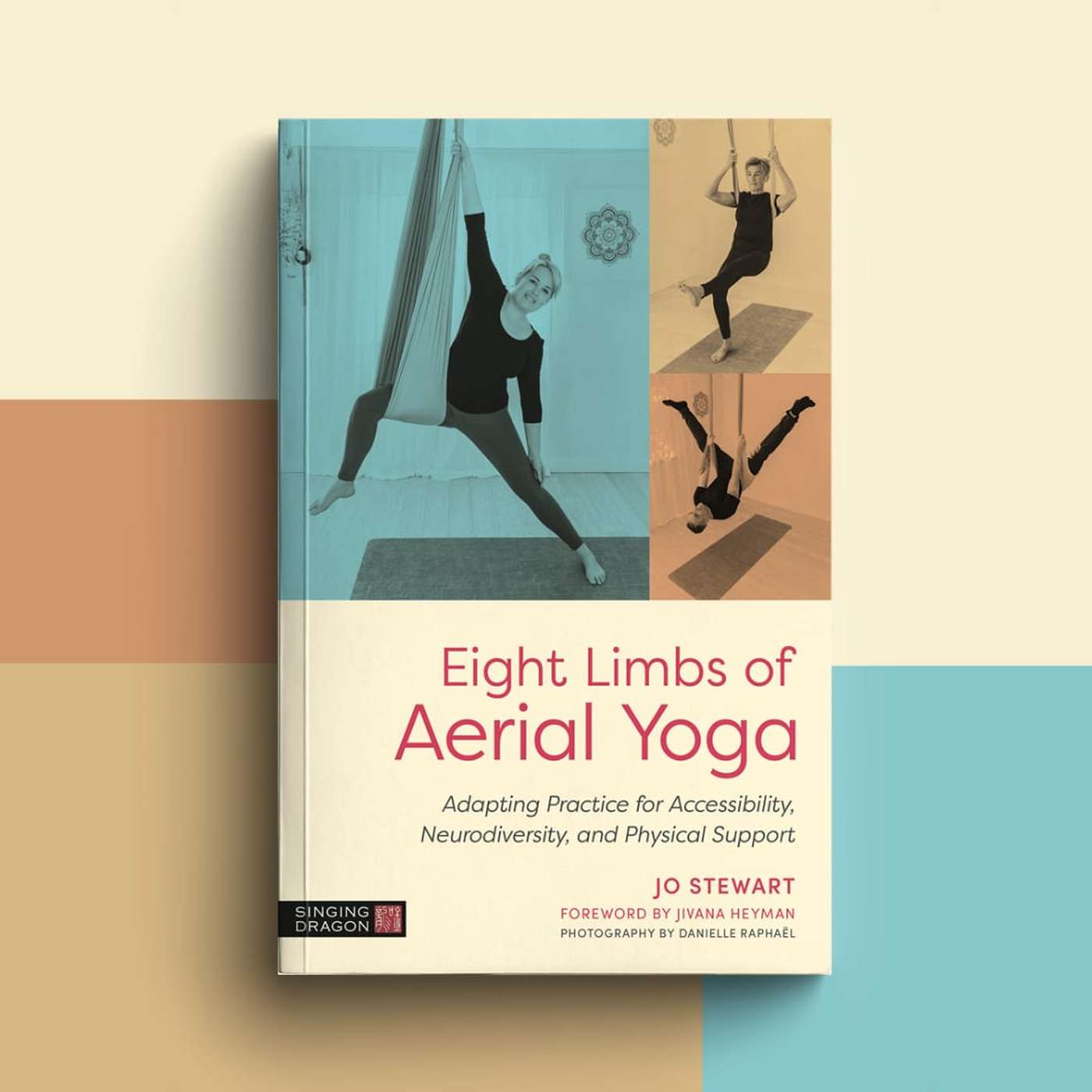
Rane here, and I honestly can't believe this day has finally arrived. My wife Jo Stewart has officially launched her book, Eight Limbs of Aerial Yoga: Adapting Practice for Accessibility, Neurodiversity, and Physical Support, and I am so incredibly proud of everything she has poured into this work. This episode captures the live online launch event, and it is one of my favourite things we've ever put out into the world.
We were lucky enough to be joined by the legendary Jivana Heyman, founder of Accessible Yoga and author of multiple books himself, who just happened to be visiting Australia when the launch was scheduled, and who also wrote the foreword for Jo's book. Jivana brings such warmth, depth, and expertise to the conversation, and hearing him talk about Jo's work with such admiration made my heart full. We also celebrated the incredible contributors who helped bring the book to life, including photographer Danielle Lara-Wooley/Raphael, 77-year-old model and contributor Maggie Turner-Miguel, and voices from practitioners and teachers around the world working in rehabilitation, neurodiversity, and mental health.
The conversation goes so much deeper than just aerial yoga. Jo shares why she structured the entire book around Patanjali's Eight Limbs of Yoga, making the case that if we're calling it yoga, we need to actually do the philosophy — not just the poses. We talk about how the aerial hammock functions as an incredibly versatile prop for accessibility (think: a bigger, more fluid version of a chair), how it supports neurodivergent practitioners through the vestibular system and sensory feedback, and how concepts like aparigraha (non-grasping) and pranayama (breathwork) translate beautifully into aerial practice. Jo even reads a chapter, and I read one myself. It's awesome.
Some moments that I think you'll love: Jivana leading us all through a grounding breath practice at the start, Jo's honest reflection on writing over 100,000 words when she'd pitched 55,000, and the behind-the-scenes story of how much lint-rolling goes into professional book photography. We also break down the three cover photos and why each one was chosen to represent accessibility, all stages of practice, and the reality that aerial yoga is not just for young, hypermobile circus performers.
If you've ever wondered whether aerial yoga is "real yoga," whether it's accessible for your community, or whether someone can write a book that's both philosophically rigorous and genuinely warm and human - this episode is your answer. Jo, I love you, and I'm so proud of you.
Links
Get the book: https://gardenofyoga.com.au/learn/eight-limbs-of-aerial-yoga/
Transcription
Please email us to report any transcription errors
Rane: Hello, my name is Rane and this is the Flow Artist Podcast. Together with my co-host Jo Stewart, we speak with extraordinary movers, thinkers, and teachers about how they find their flow and much, much more. We have an extra special episode for you today because it's a recording of the launch of Jo's book, Eight Limbs of Aerial Yoga: Adapting Practice for Accessibility, Neurodiversity, and physical support. This was an online event we held on the evening of April 24th on Zoom, and it was extra special because friend of the podcast and founder of Accessible Yoga, Jivana Heymann, happened to be in town for some trainings he's doing here, and he was generous enough to host the event. I'm extremely proud of Joe for this wonderful accomplishment, and I'm so happy that this book is finally out.Rane: All right, let's get into the event. Alrighty. Well, welcome everyone to the release of Jo's book, The Eight Limbs of Aerial Yoga. So great to have so many people here today. So many familiar faces and a few I don't recognize. I guess I'd like to start by thanking the, the people who founded or created the practise of yoga that we practise today, and I'd also blighter, honour the traditional custodians of the land. We were recording this, the Wurundjeri people of the Kulin Nation. And I guess, first of all, I'd personally like to say a heartfelt congratulations to Jo on finally publishing her book. She's worked so hard on it over the past few years, so it's great to finally have the book out. And we'll be able to have a copy soon. I'd also like to welcome Jivana. It just happened that Jivana is over on this side of the world teaching a few trainings, so he kindly offered to help us by hosting this event. So we are very glad to have you here. And Jivana is the founder of Accessible Yoga and author of too many books. So perhaps I'll just hand things over to you, Jivana.
Jivana: Okay. Thanks so much, Rane. And thanks everyone for being here. And I'm excited that I'm getting to be here personally with you. I'm gonna give you a hug. Yay.
Jo: Yay.
Jivana: Congratulations, Jo. I'm hugging, I'm hugging you for all of these people, cuz I can tell they all love you and they're all excited for you. So there, that's—
E: yay.
Jo: Thank you.
Jivana: Yeah, it is exciting. I mean, I, I really feel like my being here was great timing cuz like I had no idea this would coincide with the you know, launch of your book. And I got to write the foreword for this book, by the way. Here it is. So it's Eight Limbs of Aerial Yoga: Adapting Practice for Accessibility, Neurodiversity, and Physical Support. Oh, look, and there it is on your, on your Kindle, right? Awesome. And like I said, I got to write the foreword, which I was very privileged to do and really excited about. It's such a great book. I'm excited for it to be out in the world. You know, I have written a couple books and it's, it's kind of, It's a little scary. It's like you're putting yourself out in the world in a way, you know, like you spend so much time and energy and you kind of write in, you know, just alone a lot and you kind of explore your personal feelings and experiences and really share yourself in a book. And I can tell, I mean, I know from reading it that Joe really did that. So I think I just wanna say like, I, I get the excitement and also the fear that can come with it too. Like here it is out in the world now, like the thing that you've worked so hard on. So And it's an amazing accomplishment. And also it's a, it's an incredible thing to offer the world to be able to have a book out there that shares all your experience and knowledge. And I think this is a really special book because it's something that I also know little about, which is aerial yoga. I mean, I know a lot about yoga, but not a lot about aerial. And so I learned a lot from reading it and from knowing Joe as well. So I think it'll really serve the yoga community well. Especially the accessible yoga world, which is what I'm mostly interested in. And hi Donna. I see Donna's here. Donna, it must be the middle of night for you. Well, I don't know what time it is here. Oh, maybe it's the middle of night for me.
Jo: Morning. I was thinking, yeah, it's like 9:00 AM or something.
Jivana: It's the middle of night for me cuz I've just come from California like 2 days ago. So forgive me if I don't make a lot of sense because my brain thinks it's, I don't even wanna tell you.
Jo: Yeah.
Jivana: 1 in the morning. So anyway, so let's talk about the book. I wonder actually, maybe, maybe we could do a little centering practice. Would that be okay? That would help my brain. And since this is yoga, should I lead something? Absolutely.
Jo: Yeah, that would be great.
Jivana: I think I would benefit from that as well.
Jo: Okay. It'd be good for you.
Jivana: Yeah. So let, maybe we could just take a moment. So maybe sit back if you're seated, take a breath and cheque in with how you're feeling. And we could do 3 long sighing breaths. And this is basically, it's a pranayama practice, but we don't have to tell people that. It's just a way of getting connected with the breath and with that long, long exhalation. So together, let's take 3 long, I mean, 3 deep inhales and long exhales, making kind of an ah sound on the exhalation. Okay. So join with me.
Jo: Uh, no.
Jivana: Thank you for doing that. So it's funny, you know, to be excited about something and also be a yoga teacher is hard because we have to be calm and centred and excited at the same time. It sounds like— how does your nervous system handle that? You know, how do you feel about it? So how are you feeling, Jo? Let's hear from you.
Jo: Well, I feel like being calm about stuff and being excited about stuff is actually very much part of the aerial yoga experience because you get play. Sometimes you get to hang upside down. You get to do things that maybe you didn't realise were a possibility for you, but also you get to relax and be held and be supported. And I feel like that is one of the amazing things about this practice. It just kind of expands the range of possibilities of what we can do and also can make like the subtle aspects of the yoga practice, the relaxation and the meditation, sometimes a lot more accessible just because you can get comfortable. And I feel like if I've got any kind of physical destruction going on, that is where my mind goes. So thank you so much for starting with that beautiful centering practice, Jivana.
Jivana: Yeah, it feels like aerial yoga is a way of really being held. You know, while you're doing yoga and not, you're not just like floating free in the world. You're actually being contained and held and embraced, which feels really nice.
Rane: Yeah.
Jo: Yeah. And for some people, I think it helps them feel their bodies more because you're not just in space. You've got like that contact and sometimes it's resistance and sometimes it's support and sometimes it digs in there a little bit firmly, but it's another way of sensory interaction.
Jivana: And before we talk more about Ariel though, I wanna hear about you right now.
Jo: Yeah.
Jivana: Just if that's okay. I think everyone here cares about you and just wants to know how are you feeling like about this, about the book? Like being out there, you know?
Jo: I think like I'm really excited that you are all here and that you are here, Jivana, because it's been a little bit weird, like releasing a book on the other side of the world.
Rane: Yeah.
Jo: Like I did an Instagram post, but like it's not the same as, I don't know, like my other experiences have been like art exhibitions and stuff where it's all there. So this is definitely feeling like more of an event and more of a celebration and like the excitement is kicking in a bit more.
Jivana: Yeah, that's good. You know, one thing that you and I talked about during the book writing was that you have you had a lot more content than you could put in this book. I know that you had stuff that you had to take out and I, you know, I just wanna say that the thing about a book, it can feel so like solid and like here it is like a finished product, but you always will have another one, you know? And I think that's what's a nice thing to know is like you can just write another book.
Jo: So that was really reassuring. Like that was really great writing advice. Like don't try and just make the chapters shorter, just take the whole chapter out and save it for your next book.
Jivana: Yeah. And so I'm excited, I'm excited for your future books.
Jo: Thank you.
Jivana: I was wondering if you could talk about it a little bit more though. So there's a few things about this book that I think are really amazing. One, one to me, not only is aerial yoga really interesting and I think such a specialty and not talked about very much, at least in the context of accessibility. In fact, it's almost never, I, I don't know if I've ever seen a book that approaches it from that angle. Because I think it's normally seen in this other way, right? It's normally seen as something more acrobatic or like, you know, I don't know, like circus arts. So I just wonder if you could talk about that, like just your interest in making aerial yoga accessible. And then the other piece I was gonna ask you at the same time is around the 8-limbed piece. So I could talk about the way you brought in yoga philosophy.
Jo: Yeah. Well, actually chair yoga has been a really big inspiration for how I teach aerial yoga because The hammock is just like a bigger, more fluid, more versatile, more expansive chair.
Jivana: Okay. Yeah.
Jo: So, you know, you can use it to bring the floor up to the person if they're not great getting down to the ground. And I feel like the best way to view it is just like a new yoga prop.
Jivana: Mm-hmm.
Jo: So it's not like a whole new novelty thing. It's just like another prop to add into the yoga repertoire. And a particularly versatile one. And the Eight Limbs came in because I feel like a lot of aerial yoga teacher trainings are like quite short and very focused on the hammock and the poses. And I think if we're going to call it yoga, like we really need to make it yoga. Like we need to bring in the philosophy and the ethics. And if we're not doing that, then it really is like aerial acrobatics. Or just like an aerial stretch class or something like that. But yoga philosophy is so expansive. And what drew me to the 8 Limbs was it was already a framework. So it was already kind of a, a way of organising these ideas and an aspect of yoga philosophy that I think a lot of yoga teachers would already be familiar with. And I could see how I could use like the Eight Limbs framework, like to be the structure of my book.
Jivana: Yeah.
Jo: Whereas other yoga philosophies are so expansive.
Jivana: Yeah. It's just, it's like too much.
Jo: It's limitless. Yeah. Yeah.
Jivana: It's interesting cuz it feels like Eight Limbs. I also kind of imagine it like that when you're out like floating in the hammock that there's like eight limbs. Kind of like a, you know, like you're an 8-limbed creature. But I love that. I love the way you've talked about philosophy in this book. And I think the reason that we're friends is because I also love philosophy. So I mean, the reason that we like to chat and you do it so beautifully in this book. I really think the way you talk about yoga philosophy is amazing. And I know you're gonna share a bit about that more, but I had one more question. Well, I have a lot. Do I have, how many questions can I ask you? Okay. I wanted to ask you about, in the subtitle, you talk about neurodiversity and I feel like in the book there really was that theme of looking at that piece of yoga practice. And I, I just wonder if you could talk about that, like, what is—
Jo: absolutely. And I've learned so much from my studio community in that regard. And I think one of the key things about the hammock is it can meet you where you're at, and it just gives you all these different sensory options. So if you need movement to regulate there's a lot of ways that you can gently move while still being supported. And I've definitely heard like a criticism in class of how some people find other people's movements distracting. But when everyone's in their own hammock cocoon, like you don't even notice. So you don't have the sensory distractions of what's happening in the room around you, which I think can help you have that space to be with yourself and to tune into what you might need. But the other really cool thing about the hammock is it gives us so many ways to work with the vestibular system, which can also be regulating. So whether that's like being held and supported or like a very gentle forward and back motion, which tend to be more soothing movements, or like the more stimulating movements like upside down and spinning and like unpredictable moves, like some people need that to feel regulated. And there are some aerial yoga poses where we can be in the same basic shape and have all those options and all of that space for people to explore. And just like seeing that in my classes and seeing the different ideas that people have and the different things that people do has really like, I feel like that's where the magic is.
Rane: Yeah.
Jo: And that's what I was really excited to share in the book.
Jivana: It's amazing. I mean, the book is incredible that way. I, I was really surprised because I, I had a limited view of aerial yoga myself and you really opened my eyes.
Jo: Great.
Jivana: You did, because I just felt like, yeah, you touched on so many things that feel to me like essential to yoga and that there's that sensory issue, which is basically in the 8 limbs, right? You have pratyahara, which is the 5th limb of Ashtanga, the 8 limbs of yoga, which is sense withdrawal, which is actually probably the most important part of the 8 limbs. I think that are lost, you know, and not really taught clearly in, in yoga, in contemporary yoga practice, which is to look at the information you're taking in through your senses and the way you're connecting with the external world. So I love that part. I love how you talked about that in the book and the way that the hammock can help to connect you or like either quiet your senses or stimulate them. It seemed.
Jo: Thank you. Oh, that's so great to hear. And I feel like, like our world today, there's so much sensory input that like to have that space and even a visual sense of like the cocoon. It's so helpful.
Jivana: Yeah, it's beautiful. What else? What about the, the, I know you're gonna talk a bit about the yamas, is that right?
Jo: So we're gonna, yeah, I'm gonna talk about aparagraha, which is the fifth yama.
Jivana: But I wonder if you could talk a little bit about the subtle practises in aerial yoga, cuz you know, the, the last three limbs we have are dharana, dhyana, samadhi, right? Which is concentration, meditation, and enlightenment. I just wanted to know, I really like the way you talked about them in the book. I wonder if you could share anything about that.
Jo: Oh, well, you were my go-to, especially for the samadhi stuff.
Jivana: You liked it.
Jo: Yeah. Samadhi. Enlightenment. Let's see.
Jivana: Who am I? I don't know anything about it. I was probably thinking about you when I wrote those.
Jo: Well, I think the concentration and the meditation ones are really interesting because Concentration is a little bit more important when learning aerial yoga than, say, chair yoga or yoga on the mat, because things can go wrong. Like, you have to have a clear sense of where your hammock is, what's keeping you in, what's keeping you safe. Do I need to grip, or can I just relax and settle into this? Or do I need to, say, engage one part of my body and then let the rest relax? And Even just navigating the fabric, even if it's not a safety thing, it can be confusing and it can take a bit of brain power and energy to figure that out. But that mind-body project can actually be super helpful because if you've come from the very distracting day and now you have something happening here and now in this moment that you can feel in your body, that's like sometimes like a puzzle for your mind to unpack as you make these new pathways of movement. Like that's definitely a mind state that we travel through. And then we just settle into the, like the dayana, like the being present. And suddenly you realize, oh, I can just be here and I can just breathe into this feeling and I can like let go and decompress and just be present. And I think it's like a learning evolution with some of these poses. Like as you are learning them, it's a lot of focus and a lot of concentration and then like you'll have this moment where you're like, ah, like I can just be here. And because sometimes that's a longer journey that might take weeks or sometimes even months.
E: Yeah.
Jo: I do always like to finish the practise with a pose that is comfy and supportive for everyone. Mm-hmm. Whether that's like lying in a cocoon or sitting in the hammock, or if those aren't good options for you, like lying on the ground with your legs in the hammock. So that everyone has that experience where you don't have to think, you don't have to organize, like you can just be and rest and settle in. And I think there's something about that, that feeling of physical support.
Jivana: Yeah.
Jo: That can kind of help your mind get to the state.
Jivana: Totally. I mean, that's why yoga's so effective. I mean, that's like you're describing how yoga works and I think it's interesting that aerial yoga, which I like, I feel like is not, is not before this has been seen as the way into that more subtle practice. I think that's what you've shown in this book is that this practise that we think of as more physically oriented is actually really effective for, for helping people turn within, look at how they're dealing with the external worlds and become more focused and concentrated. So I really appreciate that. I wonder, I wonder if you could talk about the contributors. You know, you had a lot of people that you Maybe some are here. Yeah.
Jo: Yeah.
Jivana: Like about how you shared their storeys in the book. 'Cause there was a lot of that. I think a lot of real, really useful information, like, like kind of examples of the impact of this work.
Jo: Yeah. Thank you. And I absolutely, like, I wanted to make that a big part of the book 'cause it's not just my experiences and my story. I really wanted to like share what other people were doing with the hammock. And like, there are a few people here, like I see Cyril here. Who like works in Switzerland in a traumatic brain injury rehab center. And she's an aerial yoga separate to being an occupational therapist, but she's put together classes where they use the hammock in the class. And that, I think you described it, Cyril, as like redefining the body envelope, like how the feeling of being in the hammock can help people reconnect and feel into their bodies in different ways. And Kristen's here as well, and she shared like some beautiful experiences of how like the hammock has helped support her through some hard health times and also how she uses it to work with like a neurodivergent community of kids and adults today. So I was really grateful that I could draw from them. And it's one of my goals with the book. Like I'd love to create a more globally connected community of aerial yoga teachers and practitioners and kind of like shine a light on the cool things that people are doing and like share that inspiration. But I think it's also how we elevate this from something that is just like a fitness thing or a fun thing or a circus thing to actually show like the therapeutic impact it can have. And then people who are using it as part of their other health modality are the kind of the experts on working with that community or working with the hammock in that particular way. And I feel like it was a good way to like share a broader, more expansive perspective, but also, you know, so you're saying how it can be intimidating to like share yourself in your—
Rane: yeah.
Jo: So to share other people's experience is nice. Like takes the pressure off. It's not just my perspective. Gabe as well shared their experiences with aerial yoga and mental health, both teaching and personally. And yeah, to be able to like share those lived experiences along with just what I know from my classes and my community, I feel like it's really made the book.
Jivana: Yeah, I love that. I mean, I do that in all of my books so far. I've had contributors because I think it's so nice to have the support of other voices. By the way, I just need to say like what a great writer you are. I mean, I know that I read a lot of yoga books and just because people teach yoga and have something to say doesn't mean they know how to write a book. You really do. Like you did just a beautiful job, honestly. Like it's a great, but it's a great combination of, I think of, of yoga history and philosophy and practical information. And then like this whole world of aerial yoga and these personal storeys that, you know, people who have contributed to the book, plus the photographs. Which I know we're gonna talk about too.
E: Yes.
Jivana: So, all right. So maybe should I let you read? Is that—
Jo: Yeah. Oh, before we move on, I just wanna do one more shout out, a contributor shout out to Maggie Turner-McGuire, who both shared her lived experiences and was an amazing model for the photos and is my go-to when people like Maggie, I hope you don't mind me saying your age, Maggie, are you 75? And 77. Yes. So when people like see those Instagram pictures of like young hyper bendy circus people doing these poses, I was like super grateful for Maggie's contribution of her time and her energy so that I could show someone in their 70s doing these poses and just totally nailing it. She brought so much amazing energy to that day, so. Thank you so much.
Jivana: That's awesome. Thanks, Maggie. So yeah, I think you're gonna read a short—
Jo: I am gonna read a short chapter.
Jivana: Yeah.
Jo: Sorry, I chose one of the shortest chapters in the book, but I think it is also, it is a little favourite one. So my chapter is on apahigraha, and it's an interesting concept to explore in aerial yoga. It translates as non-grasp. Gripping, but we actually do have to do quite a lot of gripping and grasping to navigate our way around the aerial hammock, as well as actively working on our grip strength. Going beyond this most literal interpretation, this concept could also be interpreted as releasing our attachment to achieving a physical goal, like executing a particular pose, and instead tuning into some of the subtler benefits of this practice, such as cultivating peace of mind or simply being present without expectation. For many of us, a certain amount of physical challenge can feel helpful to find our way to present moment awareness and peace of mind. And we'll continue to explore that in the santosa and the tapas sections in Chapter 10. If we're going to stay with a literal interpretation, The concept of a pārighraha can be a useful check-in, especially as you become more familiar with aerial yoga poses, especially the ones that do require some strength and effort. Sometimes we can be unconsciously gripping harder than we need to and holding tension in our bodies unnecessarily. When we first learn a new pose, especially something like an inversion that takes us out of our comfort zone, it's normal to work really actively and relaxation might not be a realistic suggestion. However, once we get familiar with a pose and we're really clear on the safety aspects, it can be an interesting check-in to see how much unconscious gripping, tension, or holding we might be doing and how much of that we could let go. In a shape like the basic inversion, it can be a completely different experience to just hang out. Could this then flow into our everyday experience? Where are we holding tightly? What are we grasping for? And would it be possible to release that grip and just be?
Jivana: Yay.
Jo: Thank you.
Jivana: That was awesome. I think we need you to read more. Or is Ron going to read?
Jo: So yeah, Ron is going to read the pranayama chapter now.
Rane: No, I'll just, I am going to read the chapter on pranayama. So any pranayama practise that you would normally perform sitting or lying down can be practised in the aerial hammock. So rather than giving instructions for individual practices, I'll focus on how the aerial hammock can help, as well as what to watch out for. The aerial hammock can be a helpful tool to make pranayama more accessible because it can enhance our ability to feel our breath. As Ron Bowen explains, that's me, even as you're just lying in the fabric breathing, you can feel your body expanding out into the fabric. You get that feedback, that slight lift. And then as you exhale, your body sinks down into the fabric as your body contracts. And I actually do use that as a cue in a lot of my meditations and classes. And I personally find it really useful to just get that immediate feedback. I think it's absolutely beautiful. Many pranayama practises focus on diaphragmatic breathing, but just telling people to breathe more deeply isn't always helpful. If you don't already have the internal awareness to feel where you're directing the breath, the fabric can give you something more tangible to feel into. As Ran explains, it can be good for noticing where in your body you're breathing. Because you know if you're breathing closer down to the belly, that part of the fabric is going to expand, it's going to move. If you're breathing higher up in the shoulders, that's where you'll feel it. That's what I think is one of the most useful things about the fabric, the immediate feedback. While pranayama practises can be beneficial for working with stress and anxiety, these practises can also feel stressful, frustrating, and uncomfortable. And can even lead to anxiety or a panic attack. For many people, focusing on the breath is not a relaxing sensation, and it can also be really challenging to try to breathe in a different way from our habitual patterns. Pranayama should always be an opt-in practise and delivered in a way that gives people the freedom to adjust according to their own capacity. In feeling, this is a skill that you can that can also take time to develop. If you're not used to working with the breath, you may not know how much is too much. As Dr. Lawrence Hobart explains, when you're teaching pranayama, do your best to avoid sounding controlling. If we're not careful, pranayama instructions can sound regimented and controlling, and this may be triggering for people who've had an experience of trauma that involved being controlled. It can also encourage students to override their own instincts about their breath, which is the opposite of what we want to do. I usually preface any breathing practise with the instruction that if you start to feel uncomfortable at any time, it's always fine to let the practise go and focus on something else, such as the sounds that you hear or the feeling of the fabric, and let your breath do its own thing for a while. Learning to breathe in a different way can take effort and concentration, and this can be part of the mind-focusing benefit. But I try to frame that as an exploration that you can take at your own pace, rather than counting out specific ratios or trying to get everyone to synchronise their breath to my rhythm. It's also not helpful to describe a practise as soothing or relaxing when not everyone will be feeling that way. It can be useful to try something for a short amount of time and notice the effect it's having on your own state of mind before deciding to continue or not. You can dip in and out, and the aerial hammock can provide a sense of personal space to do what's right for you and reduce distraction or group pressure from the room around you. Honing our ability to observe the breath and how it affects our state of mind in stable, supported positions can help lay the groundwork for continuing this observation in more complex postures and inversions, helping us to monitor how long to stay and how deep to go.
Jivana: Yay.
Jo: Thanks, Ron.
Jivana: Thanks, Ron. That was great that you quoted yourself.
Jo: Yeah. But had some great insights to share.
Jivana: I love that. I love that section on pranayama. So I think next we're going to talk about the photographs a little bit. And is it Danielle is here, right? Yeah.
Jo: Yeah. So Danielle Lara-Wooley or Danielle Raphael. Hello. Hi guys.
E: Dani, congratulations.
Jo: Oh, thank you. So exciting. And for people who don't know Dani, like I could not have a more suitable photographer for this project. She's also a yoga teacher and works in disability as well as being an amazing photographer. And like Dani just did this incredible job of really clearly showing what I wanted to express in each pose and kind of getting that really clearly from me, but also making art. Like, I feel like the photos that you created were so beautiful and it's such a big important part of the book that I'm super grateful for everything that you put into it. It wouldn't be the same book without you. And before we go further, I do want to like remember to thank the Yoga for Good Foundation who so generously gave me grant funding to cover the photo portion of the book, and I definitely wouldn't have been able to do it to this scale without their help. So, Ron, do you have anything you wanna share about working with Dani?
Rane: Well, I remember having quite a lot of fun.
Jo: Oh yeah.
Rane: So it was actually doing, doing the aerial yoga poses for photos is, it's actually a bit harder than you'd expect because you're sort of holding, holding what is supposed to look like a fun and relaxing pose for quite a long time. Yeah.
Jo: Or holding more is a transitional moment. Yeah. It's quite a long time. Yeah.
Rane: Yeah. So by, by the end of day 1, I think I was definitely feeling a little bit better, but I definitely, I, it was, it was a fun process and great fun hanging out with the, the 2 of you. So yeah, no, I had a, I had a good time.
Jivana: I agree.
E: It was a lot of fun.
Jo: Yeah. I was just gonna ask how it was for you, Danny.
E: Yeah, it was, it was a just a fun experience. I mean, there's like Rhonda said as well, I mean, there were a lot of other things to think about. It's not just the pose that we're trying to capture, it's, you know, the, the aesthetic elements of it. And then also being mindful of how the people that are holding the poses are feeling, making sure they're having the breaks, not getting dizzy, all these other things as well. So yeah, it was, they felt like big days. I think there was a lot to think about and be mindful of. But I just felt like I was such on such a high after each time we shot was, yeah, it was such a lovely experience.
Jo: And you really brought such a beautiful vibe and energy to the studio space because none of the people who are in the book— had anyone been professionally photographed before? Like, and yeah, you put it— you really made everyone feel so at ease and so at home. And then she's crying really bad. One lesson I learned was how much book photography is about lint rolling. My lint roller got a workout.
E: Yeah, that was, that was Ron's job, wasn't it? The pole extraordinaire.
Rane: I wasn't, I wasn't that great at it either.
Jo: Sorry.
E: I know you did well.
Jivana: Thank you.
Rane: Thank you.
Jivana: Well, also maybe we could describe the COVID because on the COVID behind Ron, you just, You know, you can see enlarged there is 3 of the photos, right? That are, you know, maybe you could describe the poses that you're doing. Okay.
Jo: So I'm, I've got a blue background and I have my one thigh in the fabric. So it's like a variation of Virabhadrasana 2, Warrior 2 pose. And I'm reaching up to hold the hammock as I take the side stretch. And I think that's a really good example of a pose where The hammock is challenging balance because instead of having my foot on stable ground, it's in a hammock that can move. But because I'm holding up high, I'm not going to fall down. Like, I can keep myself safe. And maybe as I feel more comfy, I could go from gripping that fabric to just touching it, or even bringing my hand away from that fabric up above. Maggie is in the top right corner, and she's in a really supported pose. So the fabric is wrapped around her back and she's holding it with both hands and she's lifting up one leg. And this is exactly the way that I work with balance with people who need support with their balance, maybe who don't feel comfortable doing a standing balancing pose. The hammock is there and you can hold on to it, but you can also like build up your strength in both your standing leg. And it's the lifted leg in this one that gets pretty tired and especially quadricep muscles. So this is one of my go-to favourites for for people who are working with knee issues and wanna build up the muscle support around their knees. It doesn't involve getting down on the ground, and even though her standing leg is bent, you could stand up taller with less of a bend in that standing leg if that's a better fit for you. And Ron is doing one of those transitional moments that you hold for a long time. He's in an inversion. The hammock's wrapped around his hips. His legs are wide and he's holding onto the fabric with his hands. And this is an option that I start with because not everyone is gonna be comfortable being completely upside down.
Jivana: Yeah.
Jo: It's good to keep a hold and to slowly lower yourself down so you can just cheque in with how you are feeling with that, but also so that your body has time to adjust to having the head below the heart like that. And when, when he felt comfortable too, he could release all the way down and maybe let go of the hold with the arms.
Jivana: Mm-hmm.
Jo: But this moment here is really key for new people because sometimes people find their way into a pose and then something happens and they feel scared or confused and the exit becomes really challenging and confusing and scary. So if you're in this in-between moment where you're holding your hammock, that's a great place to practise coming down, coming back up again. Maybe going a little bit further down the next time so you can see how it feels to come back up from that. And just to make that muscle memory of how you get out of the pose as you're making your way into it.
Jivana: That's awesome. Thanks for describing that. I love the way you said that in the picture and what you're doing, that Warrior 2, that it's challenging balance. I thought that was really interesting. You know, the way that we can use a prop to make an asana easier or more challenging. Also, I was thinking about, you talked about the vestibular system before, and I, I've read research that shows that the vestibular system is associated with the emotion, with emotional regulation. And so that seemed like a really interesting thing to consider in this work, you know, that like working on balance and working on understanding where the body is in space, which is really what the vestibular system is doing, right?
Jo: Yeah, absolutely. And then like what I was saying before about how like the vestibular stimulating poses, like inversions, one of them, like sometimes that's what you need to feel regulated. And sometimes you need something soothing.
Jivana: Yeah.
Jo: It is actually one of the things that can be one of the reasons why people just really don't like aerial yoga as well. Like if you're really sensitive to motion sickness, then it might not be as relaxing for you. There's still poses you can do and standing poses are a great choice. Yeah. But those floaty fluid cocooning ones, right?
Jivana: Yeah. It's like sensory deprivation potentially, right?
Jo: Yeah.
Jivana: So I was hoping we could talk about, or we could see if there's questions. I don't know if we have any, Ron, if anyone has any questions, if anyone wants to put them in the chat or come on the mic, if you have comments or questions for Joe about the book, or I could ask more questions.
Rane: What do you think? Yeah.
Jo: I also, while everyone's here and maybe while we're getting ready for questions, I want to do an extra shout out to Donna Noble. Thank you so much for joining all the way from the UK. This morning, and your book was such an inspiration for me. So it was really wonderful to talk to you about that and about your writing process. And I really appreciate your generous support connecting me with Sarah, my editor. And yeah, thank you so much for being here today.
E: An absolute pleasure, and I can't wait to, to, to read the book. I've got my copy here.
Jivana: Ah, look, there it is.
Jo: I can't wait to read it and, and let you know what I think about it. But it's an absolute pleasure.
E: And Bharat Jivneet says, I can't wait. You know, the, the world needs it.
Jo: You know, we need to make yoga so everyone feels that they're, they're welcome within yoga.
E: So thank you.
Jivana: And congratulations also to Donna. You have, Donna has a new book coming out.
Rane: Amazing.
Jivana: Which I just read, by the way, Donna.
E: Oh, did you?
Jivana: Yes, I just read and I wrote a blurb for you. Hopefully it gets on the COVID I don't know if it will, but it's such a great book. Demystifying Trans.
E: Oh, sorry, did I reach out to you?
Jo: Sorry, I'm taking over your bit.
E: I'll speak to you offline, Gina.
Jo: Well done.
E: That's a good joke.
Jo: Oh, thank you.
Jivana: Yeah. Anyway, do we have questions?
Jo: Do we have any questions?
Jivana: Anyone want to say hi and congratulations?
Jo: Oh, what was the hardest part of writing the book? Being brief. Like when I originally wrote it, I pitched them a word count of 55,000 and I think I sent it, sent them something that was over 100,000 words long at the beginning. I had too much to say. And my writing process was I just like wrote the chapter that I felt like doing, and I wrote the chapters all on different days and different times. And it wasn't until I pasted them all into the one Word document that I was like, oh wow, this is getting really long.
Jivana: But yeah, that's the version I got to read. I think I got the 100,000-word version, but it was really amazing. And like I said, the pieces that you took out I think are gonna be great in your next book, but Yeah, that's a great question. And what else was hard about it? Anything else? How about the confidence piece? I feel like there's a lot of imposter syndrome that comes up when you're writing.
Jo: I actually feel like with this, I could see kind of a need for it.
Jivana: Yeah.
Jo: So, and I felt like I was both experienced enough to like have some insights that other people might appreciate, but that's also where it really helps having a big cast of contributors because If I felt like I wasn't confident to like speak to something, I like asked a lived— it's like somebody who had lived experience of that thing or someone who like focused on that in their teaching. And if I didn't have full confidence about a philosophy aspect, I went to one of your books. So that helped a lot.
Rane: Yeah.
Jo: That helps so much. Absolutely. And also actually speaking on the podcast with a lot of different yoga people.
Jivana: Talk to a lot of people.
E: Yeah.
Jo: Yeah. I think that helped too, because I got to kind of ask some questions and like get clearer on stuff in my mind so that when I was writing it, it like, I did my yoga teacher training 20 years ago. So if I was trying to dredge this stuff up from again, like, you know, from the murky depths, it would be like much more challenging than having had like more recent conversations and interactions and, you know, time to integrate all of that, play it out in class.
Jivana: Yeah. Well, I think your podcast also gives you a chance to create a community of yoga teachers, cuz I hear a lot of yoga teachers are rather isolated working with their students. But you, I know that you really connected with a lot of other teachers and it seemed like that maybe, I don't know, maybe that gave you the confidence too, like you knew what was going on in the yoga world. Because you talk to all of us all the time.
E: Absolutely.
Jo: That's how we know each other. And also actually reading Donna's book and our conversation with her kind of gave me a lot of confidence as well, because the way that she wrote her book with a lot of lived experience sharing and nonfiction, but like a conversational voice.
Jivana: Yeah.
Jo: Really resonated with me.
Jivana: Yeah. Donna's books are great. Let's see. Karen said, I love that you have written this book. I think the benefits of aerial yoga are enormous and are not always spoken about. It's far too often perceived as acrobatic when, let's see, when in actual fact it is the most vibrant tool for exploring mind, body, and soul for all.
Rane: Yeah.
Jo: Thank you for that. And I think that's also comes back to the confidence to write about this. Like I felt like there was stuff that needed to be said.
Jivana: Yeah.
Jo: And I was really excited to share this aspect of aerial yoga.
Jivana: Yeah. It's really eye-opening. I have to say, like you've taught me a lot and I really, I think that the yoga world needs to hear this. I don't think there's enough people or anyone really talking about it in this way. So I mean, this book will do a lot of good. So I know you have more, more questions and you wanna have more comments, or do you wanna just say congratulations? I think your mom, is that your mom? Does she wanna say? I think mom should be allowed to say hello.
Jo: Mom and dad. Yeah.
E: I'm, I'm Anjo's mom and we are so proud of what she's done with the book and we're very excited about the launch and we can't wait to read it ourselves and, and learn more about it.
Jivana: That's so sweet. It's great to meet you. Thanks for being here. Yeah. So I mean, anything else you wanna share or do you want? I don't know if there's more. What do you think?
Jo: Yeah, I think that this could be a good place to leave it if no one else has other questions for us. I'm really grateful for everyone joining me and really making this feel like a celebration and taking time out of everyone's all over the world, coming from work, coming from home.
Jivana: I actually, Ron, I don't know if you're going to say something because I wanted to ask you what your experience was of Joe writing this because I know for me that You know, my husband was very patient, you know, with me working a lot when I'm writing. And I just wonder what it was like for you. It seems like it probably took a lot of Jo's time and attention.
Rane: I think Jo paced things out very well. Like, I know, I think Jo is very systematic, very organized. And I think she actually had a lot of fun organising things. What was that software that you used, Jo, that helped you organise all of the footnotes?
Jo: Zotero.
Rane: Zotero. Yeah. I think Jo was, Jo was absolutely delighted to discover that and just had a lot of fun. So no, I think I just got to enjoy the process with her. So yeah. And it's played out over the last 2 years, so it hasn't been too bad from my perspective. And I know Jo and I are both 2 people who managed to find projects and then, and then wonder how we got ourselves into this, this kind of a deal to, to start with. But one thing I, I actually wanted to say is actually I was really grateful and happy to read the, the foreword that you wrote for Joe. And one thing that stood out for me was, I can't remember the wording exactly, but you said that one of the things that shone through in the book was Joe's big heart. And actually just reading that made me feel emotional and really proud because I think it's true. And I think in every, every word you read of the book, you can sort of feel the love coming out of Joe. So I think, yeah, it's a great book and I think what you did is absolutely true. So thank you for that.
Jivana: Yeah.
Jo: Aw, thanks, Rane. Thanks, Jivana.
Jivana: Yeah, thanks, Rane. All right, should we leave it there then?
Jo: Yeah, I think that's a great conclusion. Thank you so much, everyone. Thanks for joining. Yeah, thank you for people who bought my book already.
Jivana: Yeah, buy the book, tell your friends. Congratulations, Jo. Yay!
Rane: I hope you enjoyed listening. It was really a fun event to be part of. Thanks to everyone who attended and especially Jivana for hosting. If you're interested in getting a copy of this book, just head to 8limbsofaerialyoga.com. I'll leave a link in the show notes. You can find me on Instagram as @ranelovesyoga and Jo @gardenofyoga. We love hearing from you, so feel free to reach out and share your thoughts. And if you enjoy an episode, tell your friends all about it. Thanks to Gosoul for generously granting us permission to use their track Baby Robots as our theme song. Head to Ghostsoul.bandcamp.com to discover more of their incredible music. We're grateful to our wonderful Patreon supporters. Your generous contributions help us cover the costs of editing and producing this podcast. And to everyone who listens and shares about our work. He aroha nui, māua kia koutou katoa.
Rane: Sending you big, big love.
Friends of Flow


